
You Are Funding the Wrong Engineering Budget
Every team running with AI spends against two budgets. Most fund the workshop. Few build the factory.

Engineering teams have been using Claude Code, Cursor, and Codex for over a year now. The language we use to talk about it is broken. We measure pull request volume. We argue about which model is best. None of it explains why some teams hit 50-80% productivity gains and stall, while others hit 20x and keep climbing.
The right vocabulary is older. It comes from industrial economics.
Every team running with AI now spends against two budgets. One you already know. The other decides whether you sit at 80% a year from now or run past 20x. Most teams fund the first and starve the second. They are not building a factory. They are renting a workshop.
Two budgets
CapEx buys durable assets that pay for years. Factories. Machines. Infrastructure. OpEx pays the bills this quarter. Salaries, rent, power. CapEx hurts upfront and disappears later. OpEx feels easy and never stops.
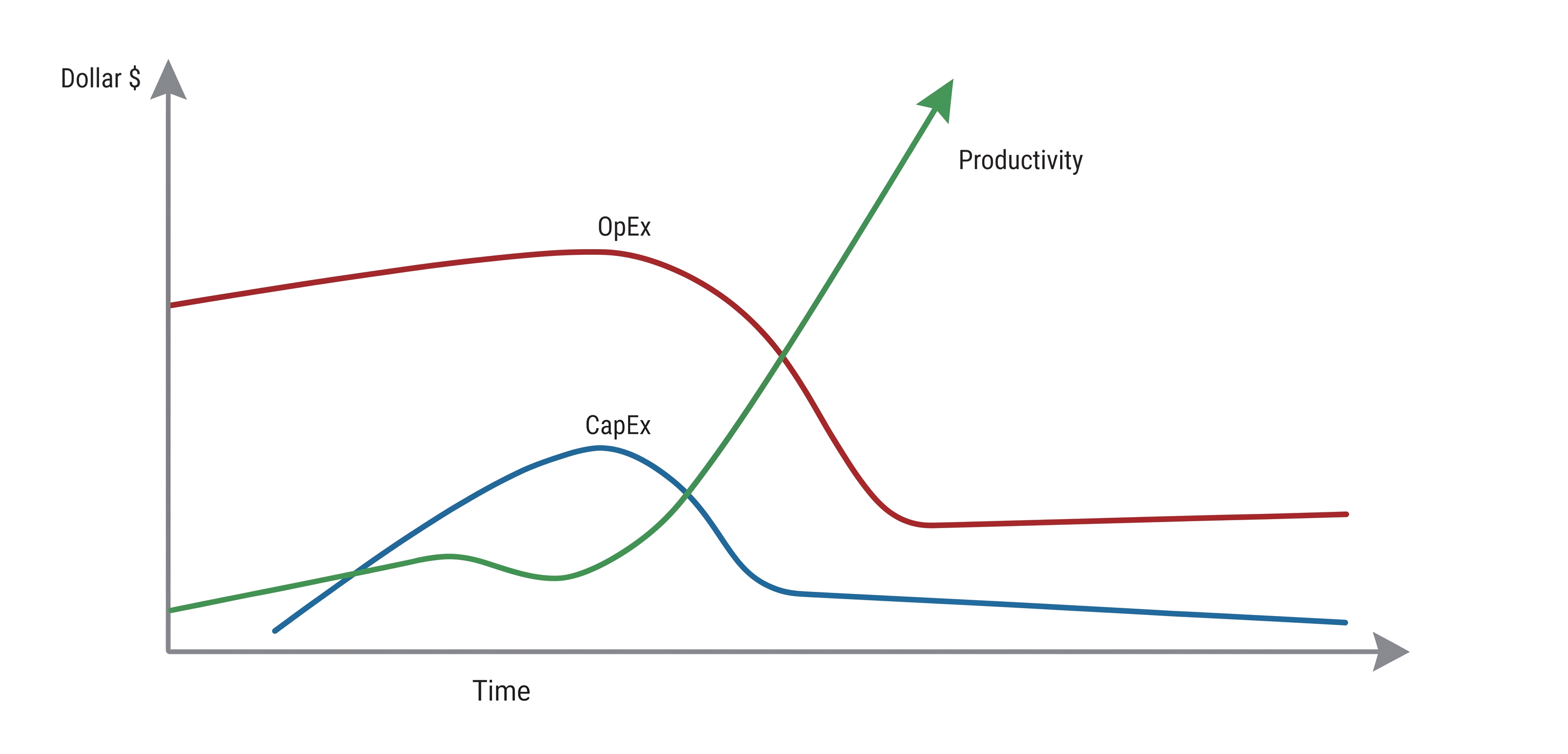
Hold the factory image in your head, because it is exactly the right one for what’s happening in engineering teams.
A team that uses Claude Code without building anything around it runs a workshop. A skilled craftsman shows up, picks up a brilliant new tool, and produces work. The work is good. Tomorrow the next craftsman walks in, starts over, makes the same mistakes, and produces about the same amount. The workshop scales with headcount.
A team that has built the harness around its agents runs a factory. The line is laid down. The Chassis are built. The quality gates are wired in. A new engineer who walks in on day one inherits everything the team built before. The factory does not scale with headcount. It scales with how well it was engineered.
Same agent. One is a workshop. The other is a factory. The output curves are not close.
Four pieces of equipment
A factory has four kinds of equipment. Each one maps to a capital investment your team has to make.
The Chassis. A fixture that holds the work in exactly the right position so every cut comes out the same. For an engineering team, the Chassis is the harness around the agent. The CLAUDE.md that captures your conventions. The AGENTS.md that tells sub-agents how to collaborate. The slash commands that encode your repeated workflows. The MCP servers that wire the agent into your internal tooling. Without a Chassis, every cut is freehand. With a Chassis, a new engineer is as productive on day one as the person who built it.
The factory floor. The building itself. For an engineering team, the floor is the codebase, reshaped so agents can read it. Modular boundaries. Strong types. Clear names. Real tests. Thoughtworks added “AI-friendly code design” to their Technology Radar last year. The agent’s ceiling in your codebase is set by the layout of your codebase, the way a factory’s output is set by the layout of its floor. A cramped, cluttered factory cannot run a high-speed line, no matter how good the machines are.
Quality control. Every real factory inspects work at every stage. Without inspection, defects compound in silence and ship to customers. For an engineering team, quality control is the verification system. Linters and type checkers wired into the agent’s feedback loop. Code review agents that grade PRs against your team’s taste. Eval suites that compare today’s behavior to golden outputs. Agents now write code at three to five times the old rate. Quality control is what separates a factory from a defect generator.
The kaizen system. Every modern factory has a process for turning each observed problem into a permanent change in the line. For an engineering team, this is the self-improvement loop. Every production bug becomes a new rule. Every retrospective updates the sub-agent’s checklist. Every failed agent run gets captured and turned into a prevention. OpenAI’s team runs background tasks they call garbage collection. Agents scan for deviations from coding principles and open refactoring PRs that mostly auto-merge. The factory maintains itself.
Each investment hurts upfront and pays for years. The workshop has none of them.
Why most teams stay in the workshop
Most teams end up in the workshop. The reason is not ignorance. The incentives all point at OpEx.
The roadmap is what gets measured. Sprint velocity is what shows up on dashboards. Nothing in standard engineering management treats “the harness got 12% sharper this quarter” as real work. So it does not happen. Or it happens by accident, on one senior engineer’s laptop. The Chassis stays in one craftsman’s drawer.
The agentic era makes this worse for a strange reason. AI now ships code at three to five times the old rate. The workshop’s output looks dazzling. Every dashboard goes up. Nobody wants to talk about building the factory because the factory does not dazzle. It just compounds in the background.
Here is the trap. Skipping the factory does not keep your workshop’s costs flat. It makes them rise. The same defects get caught by hand forever. The codebase decays at agent velocity, and a decaying floor makes the next agent run worse. Faros AI tracked 22,000 developers and found median review time up 441% and incidents per PR up 242% in teams that scaled AI without scaling the harness. The workshop shipped more. The rework queue grew faster than the shipping queue.
What factory-builders look like
Teams that have made the CapEx investment look slow at first. They pour the foundation while the workshops next door are already shipping.
The OpenAI team that wrote a million lines of code in five months said their early weeks ran slow. Codex was fine. The environment was not. Their main job became enabling the agents. When something failed, the fix was almost never “try harder.” It was always: what tool is missing, what guardrail is missing, what context is missing, and how do we encode that so this failure cannot happen again.
The investment compounded. By month three, the curve bent. The team grew from three engineers to seven. Throughput per engineer went up, not down. New engineers walked into a factory that was three months sharper than day one.
The pattern repeats at every scale. A two-person team at Cora now runs at the throughput of fifteen because their factory has been learning for nine months. Stripe’s internal coding agents merge 1,300 PRs a week, riding on top of years of developer experience investment that turned out to be exactly the right floor for agents.
These teams are not running a better workshop. They are running a factory while their competitors are still working freehand.
The question
If you lead an engineering team right now, you are not deciding whether to spend on CapEx. By default, every team spends zero. The foundation model carries the workshop to its ceiling. That ceiling is 50% to 80%. That is the freebie Anthropic and OpenAI hand you when you buy a seat. It is the output of a brilliant craftsman in a bare workshop.
What you are deciding is whether to build the factory around the craftsman. The question is not how much it costs. The question is what ratio of engineering time you protect for it. Ten percent. Twenty. Name it. Defend it the quarter product is screaming. Measure the factory as carefully as you measure the output.
Teams that do this build durable engineering capital. Teams that do not rent a workshop, pay the rent monthly, and wonder why their output never compounds. One scales. The other ends.
Pick a budget. Build the factory.