

AI has already transformed coding throughput. But more code does not translate into more impact. The gap is structural. Software engineering is not a single activity. It is a supply chain. Speed up one part, the bottleneck moves. Real progress requires an end-to-end system: from definition to execution to review.
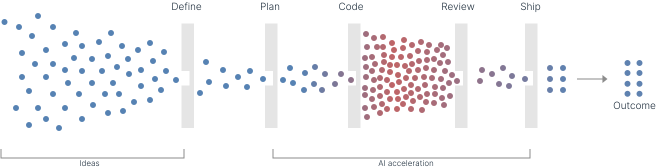
Software engineering is not a coding problem. It’s a supply chain problem.
AI didn’t remove constraints. It exposed them.
The promise vs. the reality
Over three years, we’ve built and led AI-native engineering teams across start-ups and enterprises. The promise: dramatically higher velocity. The reality: coding agents are incredible, and outcomes still fell short.
“AI will let us do more with fewer engineers.” Without redesigning the system, you just compress the same work into fewer people and burn them out.
Agents make it easy to produce code. They also make it easy to miss the rework and increase tech-debt, that has to be paid back later.
Teams that increase coding velocity quickly hit constraints elsewhere — reviews, testing, or even defining what to build next.
Push AI too hard, you accelerate debt. Pull back, you leave velocity on the table. Most teams oscillate between two, in an ever changing ecosystem.
Keeping up with models, tools, and workflows is a constant tax — on top of actually shipping software.
We’ve been through multiple cycles of this. Moments where everything felt 20x, followed by the realization that it wasn’t. That forced us to look deeper.
The InsightEverything got faster. The system didn’t.
AI didn’t change engineering. It scaled generation. Code, ideas, and reviews can now be produced instantly. They don’t remove bottlenecks. They hit them faster.
AI-native engineering often feels like driving a F1 car, with an untrained driver, absent pit-crew, on jammed city roads. You feel the thrill of driving, but keep hitting the pavement and don’t get anywhere any faster.
Push coding, and reviews break. Push reviews, and testing breaks. Speed up execution, and planning becomes the bottleneck. Systems built for human pace can’t feed continuous appetite of 24x7 always running AI agents.
There’s also a harder limit: cognition. Five people can’t manage a hundred parallel threads. Without structure, the system thrashes.
This is the shift: you’re operating a system, not doing the work.
Systems like this don’t run on sprints. They run on laps: continuous cycles of ideate, refine, execute and evaluate.
AI native teams must start running laps: a continuous cycle of ideate, refine, execute and evaluate.
That requires a new working model: a scalable execution engine and a system to continuously define and ideate what to build using it.
The Operating ModelThe Gigafactory and the Studio operating model
The Gigafactory is always on. Always hungry. A scalable execution system that continuously consumes work definition, generating, building, testing, and refining in tight loops.
But a system like this needs structured input. You can’t feed it with periodic planning or static backlogs. It runs on laps.
AI-native teams must operate in continuous cycles of ideate → refine → execute → evaluate, not as phases, but as a loop. Multiple times a day. The factory doesn’t wait. It keeps running.
Which creates the second system.
The Studio exists to feed and steer the factory. It decides what enters the system, what gets refined, and what moves forward. It interprets signals from execution, evaluates outcomes, and continuously reshapes the work.
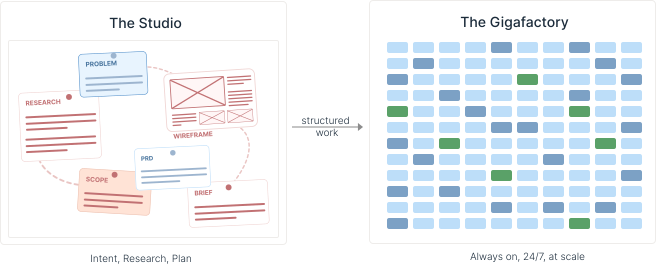
So the model separates.
The Gigafactory executes at scale. The Studio defines, selects and refines.
Together, they form a continuous system, one that can run laps without slowing down. Operating these systems is a fundamentally different responsibility and they need new role definitions.
Who Does WhatNew operating roles are needed
When execution scales, new roles are needed. Designing the system, driving it, and validating its output are no longer the same job.
Meta Engineer
Designs the systemThey design how work flows from idea to production, where autonomy is safe, where judgment is required, and how feedback loops close. Their leverage is not in writing code, but in shaping the production line itself. They ensure the system is repeatable, observable, and continuously improving.
Full Stack Builder
Drives the system forwardTakes problems from idea to production by shaping and sequencing work through the system. In a high-throughput environment, effort is cheap. Clarity is not. Continuously runs laps, framing, testing, refining, so the system is always working on what matters.
Specialist
Owns system integrityAs throughput increases, so does the cost of mistakes. Quality can no longer be assumed. It has to be enforced. Defines standards, validates outputs, and intervenes where failure is expensive. Not to slow the system down, but to ensure it can be trusted at speed.
These are not job titles. They are responsibilities the system requires to function. A single person may operate across multiple roles. A team may distribute them.
The system that actually works
The Gigafactory and Studio are not abstractions. They change how work actually flows.
Instead of managing tickets, you’re managing laps.
Work doesn’t move in phases. It moves continuously through a structured cycle: definition, refinement, execution, and evaluation. Multiple times a day.
Agents don’t operate freely. They operate inside constrained stages, where inputs are shaped, outputs are validated, and feedback is immediate.
Reviews are not a separate step. They are embedded in the system. Every loop produces something that is evaluated before it moves forward.
Planning also changes. You’re no longer trying to predict everything upfront. The Studio continuously selects and refines what enters the system, based on real signals from execution.
This resolves the core failure mode.
- Velocity no longer creates chaos, because work is structured
- Throughput increases without losing control
- Quality is enforced inside the loop, not after the fact
The system starts behaving differently. Not as a sequence of tasks, but as a production line that improves with every cycle.
The SolutionMindlap: the system you start with
Mindlap gives you a working system from day one. Not a collection of tools. Not another layer on your stack. A production loop where work is continuously defined, executed, and validated.
Instead of stitching together co-pilots, workflows, CI, and review processes, you start with a system where:
- Work enters through structured definition, not loose tickets
- Agents operate inside constrained stages, not in isolation
- Execution runs continuously, not in bursts
- Validation is embedded in the loop, not deferred
- Context & learning across team is integrated, not fragmented
The Gigafactory and Studio are not something you assemble over time. They become the starting point.
- A Full Stack Builder can take an idea and run it through the loop.
- A Meta Engineer can shape and improve how the loop operates.
- A Specialist can enforce quality without slowing the system down.
The system is observable, adjustable, and compounds with every cycle. You’re not adding AI to your workflow. You’re starting with a workflow designed for AI.
We’re working with a small set of teams to stand up their first production loop end-to-end. If you’re an engineering leader already seeing gains from AI, but hitting coordination, standardisation, or scaling limits, this is for you.